
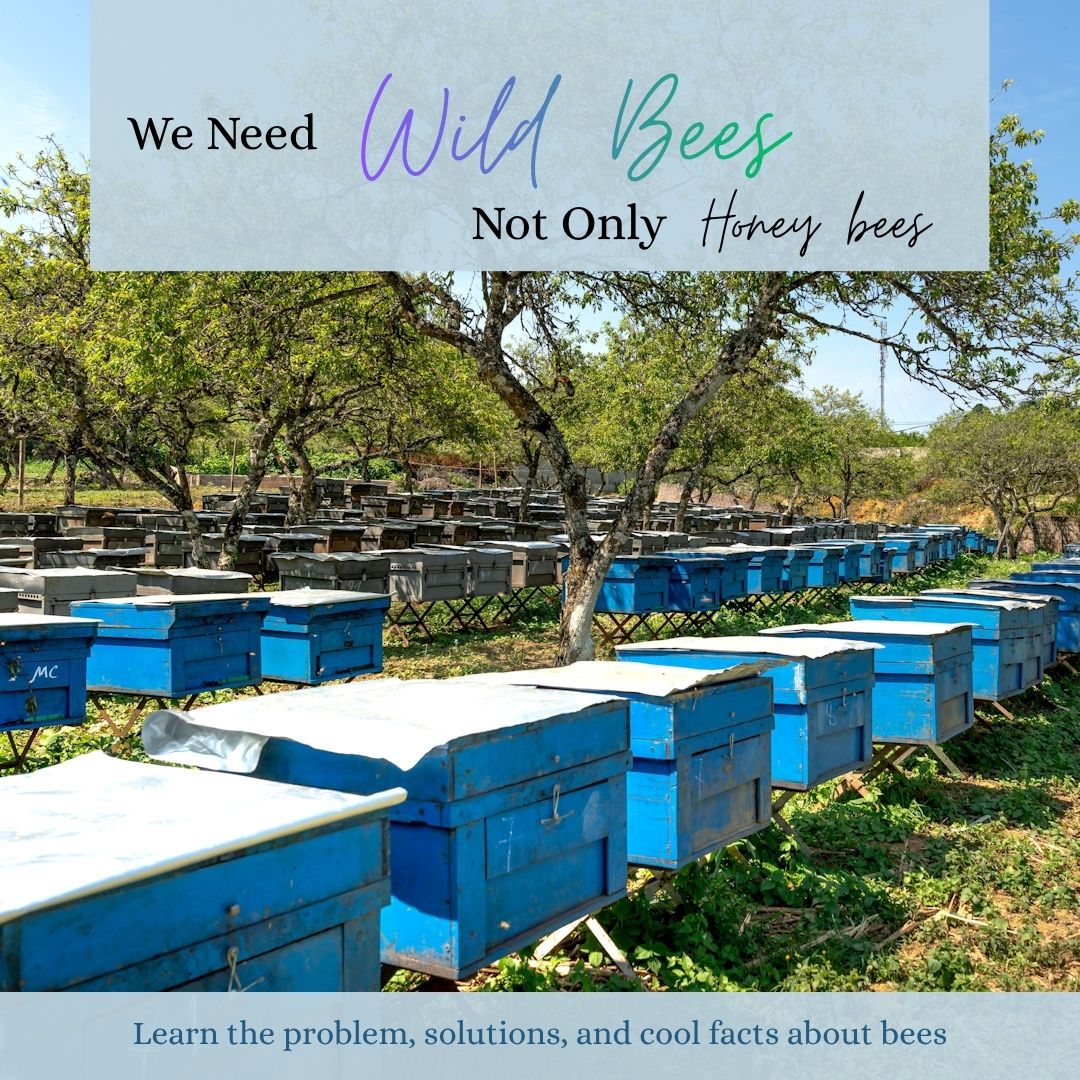
I found myself asking: what do I really know about bees, and what is worth sharing? Then I came across a Washington Post article titled “Good news: We saved the bees. Bad news: We saved the wrong ones.” The article made me think about the issue differently: our well-meaning focus on honeybees can unintentionally make life harder for native bees. In this blog post, I’ll explain how managed honeybees can compete with wild native bees, share practical ways to support native pollinators, and end with a few cool bee facts to keep you wowed and more bee savvy!
Let’s start with the honeybee issue. As was mentioned in the article, the “save the bees” movement became a powerful buzz because honeybee colonies were—and still are—under pressure. Many people responded by adding honeybee hives to gardens, farms, rooftops, and other areas. The problem is that most of that attention has gone to honeybees, while many wild native bees continue to lose habitat, food sources, and nesting places and are declining even more!
Honeybees also have a major advantage: they live in large managed colonies and can store food as honey. Many native bees live very different lives. Bumblebee colonies die back each winter, with only queens surviving to hibernate, and most solitary bees do not have colonies at all. Because they do not store large food reserves, native bees depend more directly on nearby flowers, healthy habitats, and good weather.
That does not mean native bees are weaker or less important. In many cases, their superpower is pollination. Some native bees carry pollen more loosely and effectively on their bodies, and some use special techniques such as buzz pollination, where “explosions” (vibrations) help release pollen from certain flowers.
Our love of honey adds another layer to the problem. Industrial beekeeping often moves hives from place to place to pollinate crops and support honey production. That movement helps managed honeybees survive and grow in places where they might otherwise struggle, but it can also increase pressure on native bees that are trying to find enough nectar, pollen, and nesting space in the same landscape.
When too many honeybees share limited habitat with native bees, they can exhaust resources and help pollinate non-native plants, which can reduce the diversity of native flowers. That matters because some native bees rely on specific native plants for pollen. If those plants disappear, the bees that depend on them may disappear too.
There is also a health risk. Because honeybees are sometimes managed more like agricultural animals, they can carry or spread diseases, fungi, mites, and parasites that may spill over to wild bees. Add pesticides and habitat loss, and native bees are fighting multiple battles.
That is why this issue is important: sometimes we try to help nature, but if we focus on the wrong solution or put too much attention on one area, we can accidentally make the problem worse.

Know the Problem: Practical Ways to Support Native Bees
If we want to help native bees, the goal is not simply to add more hives. The goal is to restore habitat, reduce pressure, and make sure wild bees have food and safe places to nest.
- Plant native flowers across the seasons. Choose a variety of native plants that bloom from spring through fall so bees have steady access to nectar and pollen.
- Reduce hive pressure where native bees are already struggling. If you keep honeybees, avoid crowding too many hives into one area and consider the amount of nearby habitat available to support both honeybees and wild bees. For example, for each hive you manage, you should leave an acre of land for wild bees.
- Leave nesting habitat in place. Keep some bare soil, hollow stems, leaf litter, and less manicured garden areas so ground-nesting and stem-nesting native bees have places to live. Let your yard or garden be a bit messy at times!
- Limit pesticide use. Avoid spraying blooming plants and limit pesticides (or look for greener options) whenever possible because pesticides can harm both honeybees and native bees.
- Learn before adding hives. A hive may produce honey, but native bee conservation usually depends more on habitat restoration than on adding more managed bees.

Cool Facts to Feel Bee Savvy!
- Now for the fun part: bees are not just honey-makers. They are diverse, specialized, and essential pollinators that help support biodiversity and many of the foods we rely on.
- Not all bees produce honey, and honeybees are not native to North America but instead to Asia, Africa, and Europe.
- Bees matter because they move pollen from flower to flower, helping plants reproduce and supporting ecosystems, gardens, farms, and food crops.
- There are more than 4,000 species of native bees in the United States and more than 20,000 known bee species worldwide! They come in many shapes and sizes, including tiny bees such as Perdita Minima, which are only about 2 millimeters long!
- Many native bees are excellent pollinators for native plants, and some, such as blue orchard bees, are considered far superior for pollinating native plants and certain crops.
- Some native bees specialize in visiting certain plants, which means a missing plant can also mean a missing bee. That is one more reason native planting is so important to keep them around.
- Most native bees are solitary, meaning they live and nest on their own instead of inside a large hive.
- Female bees are the best at transferring pollen on the planet.
The takeaway is simple: if we want to “save the bees,” we need to widen the story beyond honeybees. Supporting native bees means planting native flowers, protecting messy habitats, using fewer pesticides, and remembering that even the smallest pollinators can make some of the biggest ecological contributions.

Sources and Resources:
https://www.washingtonpost.com/climate-environment/2026/02/06/how-to-save-the-bees-honeybees-dying
https://www.xerces.org/endangered-species/wild-bees
https://www.xerces.org/pollinator-conservation/pollinator-friendly-plant-lists